
6
Canada PGWP Refused 2026: Why Students Are Protesting
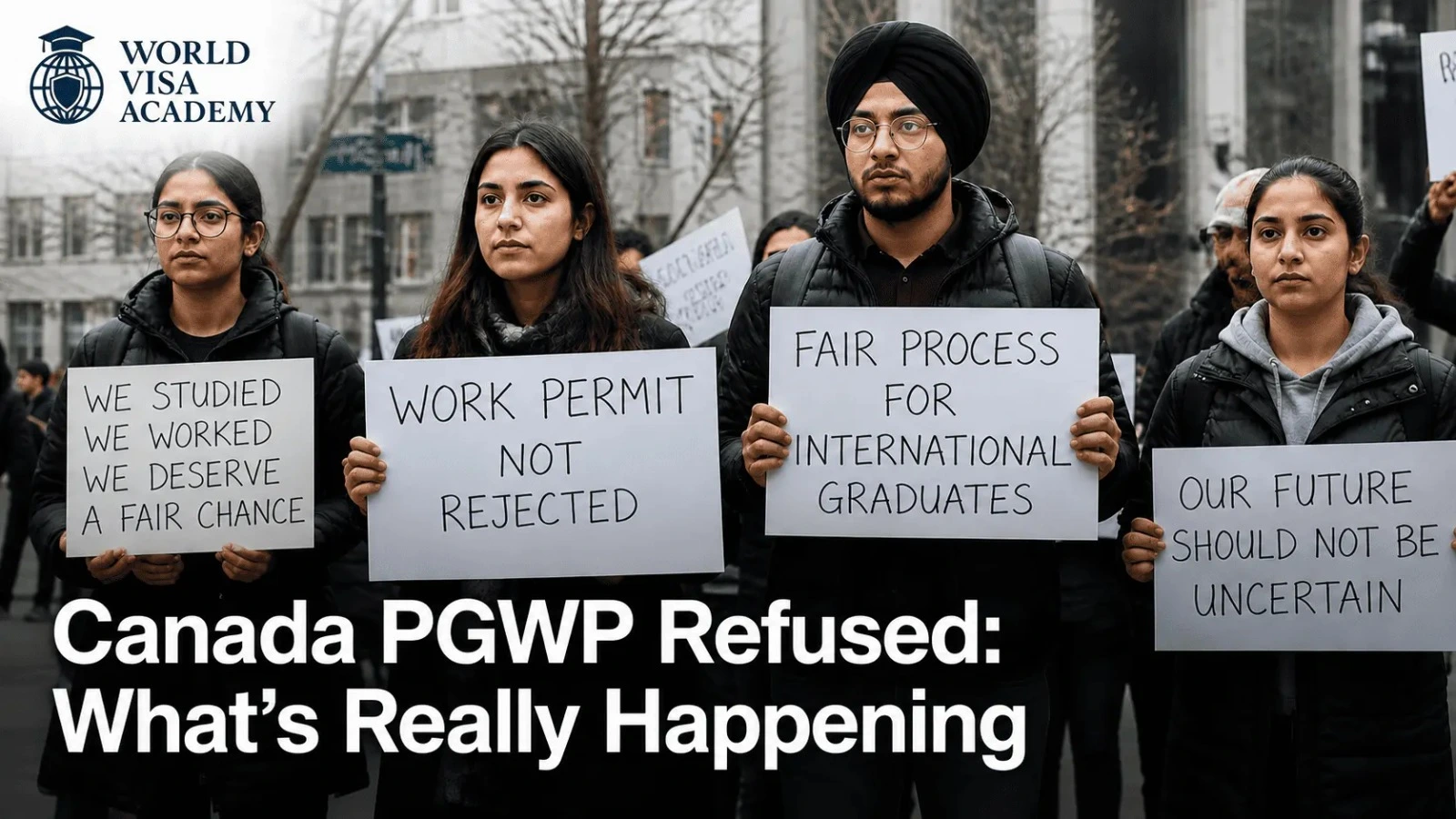
Hundreds of students in Canada just had their PGWP refused. Many are protesting outside immigration offices in Calgary right now. Some have even stopped eating food to make their point heard. This is not an old story from a few years ago. It is happening right now, in 2026.
Let us explain it in the simplest way possible, but with enough detail that you actually understand what went wrong.
The Core Problem, in One Line
Students finished their diploma. They paid full international fees. Then Canada's immigration department told them their program does not count for a work permit, even though other students from the exact same class got approved earlier.
Same class. Same diploma. Same teachers. Different answers. That is the whole problem, and it is why so many students feel this is unfair rather than just unlucky.
What Is a PGWP, and Why It Matters So Much
PGWP stands for Post Graduation Work Permit. After finishing an eligible course in Canada, this permit lets a student stay back and work legally. For a huge number of international students, this single permit is the entire reason they chose Canada over other countries. It is the bridge between finishing a diploma and actually building a career, and for many, it is also a step toward staying long term.
Losing your PGWP is not a small setback. It usually means you cannot legally work in Canada anymore. Some students may even have to leave the country they spent years of money and effort building a future in.
What Actually Happened
Here is the detailed but simple version of events.
Students joined diploma programs, mostly in business management, at Portage College, a public college in Alberta. Some of these programs were not taught directly by Portage College. Instead, they were taught by partner schools, most notably one called CIOT, using a diploma that carried the Portage College name. This kind of setup is sometimes called a curriculum licensing arrangement, or a P3 program, short for public private partnership.
In June 2026, Canada's immigration department, known as IRCC, updated some wording on its website about which programs count for a PGWP. Soon after this update, refusal letters started arriving in students' inboxes. The letters said these programs were classified as "non credit," and non credit programs do not qualify for a PGWP under Canadian rules.
By this point, many students had already paid around $32,000 in total tuition over two years. Many had already finished every class, every assignment, and every exam. They were not partway through a course that suddenly changed. They were already done, waiting for their work permit to arrive.
Why This Made Students So Angry
This is the part that upsets people the most, and it deserves a full explanation.
Two students can complete the exact same diploma, at the exact same school, taught by the exact same partner, enrolled around the exact same time. One gets approved for a PGWP. The other gets refused, months or years later, for reasons that sound identical on paper.
IRCC's official position is that the rules never actually changed. According to the department, the June 2026 website update only "clarified" existing rules that were already there, and non credit programs were reportedly never eligible for a PGWP in the first place.
But if that is true, students are asking a very fair question. If the rules were always the same, why did some classmates get approved before June 2026, while others doing the identical course got refused after it? So far, nobody has given these students a clear, satisfying answer to that specific question.
A Simple Timeline of Events
- Students joined Portage College diploma programs, some directly, some through partner school CIOT
- They paid full international tuition fees, often close to $32,000 over the full course
- Students attended classes, completed assignments, and finished their diplomas
- In June 2026, IRCC updated its website guidance about non credit programs and PGWP eligibility
- Refusal letters began going out to graduates soon after this update
- Students started comparing notes and discovered that classmates with identical diplomas had received different, inconsistent decisions
- Protests began outside IRCC's office in Calgary, growing over time to around a thousand participants
- In late July 2026, a small group of five to six graduates began a round the clock hunger strike to draw more attention to their case
- At least one student filed for a federal court judicial review of her individual refusal
- Protesters were told to leave the private property they had been standing on, so they moved their protest to public land to continue
Three Very Different Sides of the Same Story
WhoWhat They SayIRCC (Canada's immigration department)Nothing has actually changed. Non credit programs were never eligible for a PGWP. The June 2026 update only made this existing rule clearer, it did not create a new rulePortage CollegeThe college does not make immigration decisions, only IRCC does. The college has said it has no involvement in individual application outcomes, and has directed affected graduates to speak with a licensed immigration lawyer or a Regulated Canadian Immigration ConsultantAffected studentsThey enrolled and paid in good faith, based on the information available to them at the time. They completed every requirement of their program. Now they are being refused, while some classmates from the exact same program were approved earlierWhat Political Leaders Have Said
Canada's Prime Minister, Mark Carney, addressed the protests directly. He said the correct legal process must be followed for every application. He also made one important point clear, saying a PGWP exists so graduates can use their Canadian education and skills in the job market, and that permanent residency is a completely separate immigration pathway, one the protesting students say they are not even asking for.
Alberta's Premier, Danielle Smith, chose not to specifically call schools like Portage College "diploma mills," but she did admit that some private education operators have taken advantage of international students in the past. She also said Alberta wants greater authority to choose immigrants whose skills better match the province's own labour market needs.
Protesters have said that neither of these responses actually answers their real, specific question. Why did students from the same program, under the same supposedly unchanged rules, receive different decisions.
What This Means for You, If You Are Planning to Study in Canada
This entire situation carries one very important, very practical lesson. Not every diploma automatically leads to a PGWP, even if it looks exactly like another program that does. The difference can come down to small details in how a course is delivered and classified, details that are very easy for a student to miss.
Before you commit to any program, especially one delivered through a partnership or licensing arrangement rather than a college's own main campus, check these points carefully.
- Ask clearly and get it in writing whether the specific program is classified as "credit" or "non credit," since this single detail decides PGWP eligibility
- Ask whether the course is taught directly by the college itself, or by a separate partner school simply using that college's name and diploma
- Find out if there are any enrollment cutoff dates that affect eligibility for programs delivered through partnership arrangements
- Keep every acceptance letter, transcript, invoice, and email safely stored, since these documents can become essential evidence if your PGWP application is ever questioned
- Speak with a licensed immigration lawyer or a Regulated Canadian Immigration Consultant before you enroll, not only after a refusal letter has already arrived
Situations exactly like this one are why properly trained visa consultants matter so much. Understanding the real difference between a credit and a non credit program, and knowing how curriculum licensing arrangements can quietly affect PGWP eligibility, is precisely the kind of detailed, current knowledge that protects students from ending up in a mess like this. Building that level of real, practical understanding in every consultant is exactly what we focus on at World Visa Academy.
What Happens Next
At least one federal court judicial review case is currently underway, and its outcome could set an important example for how similar refusals are handled in the future. A public petition has also been started, asking IRCC to pause further refusals on Portage College related files until a proper review takes place. This story is still actively developing, so always check the latest updates directly from IRCC and reliable Canadian news sources before making any decisions based on it.