
6
Germany, UK and Canada All Changed Their Immigration Rules This Month — Here's What Actually Happened in Each
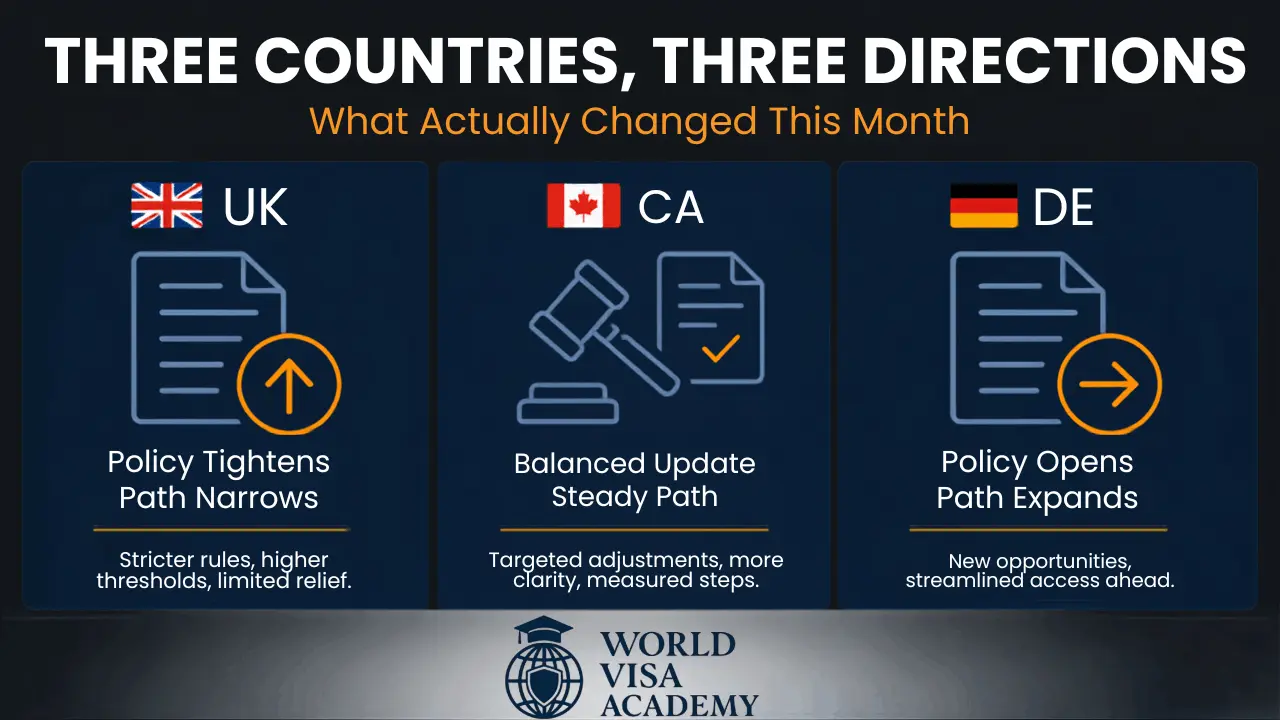
Three Countries, Three Very Different Stories
If you have seen headlines this month suggesting Germany, the UK and Canada are all cracking down on immigration together, the real picture is more layered than that, and understanding the layers is exactly what separates a well informed consultant from one repeating a simplified headline. All three countries did genuinely update their rules this month. But only two of them are actually tightening the routes your clients care about, and the third is doing something more interesting: tightening one door while quietly opening another.
Here is what actually happened in each, with the detail your clients will eventually ask you about.
The UK: A Quiet Rulebook Rewrite With Real Teeth
On July 9, 2026, the Home Office laid a new Statement of Changes to the Immigration Rules, known as HC 259, before Parliament. Most of its provisions took effect on July 30, with a further set commencing on August 3, 2026. Spanning more than 40 parts and appendices across 39 pages, immigration lawyers reviewing it describe it as not a headline grabbing overhaul, but note that several of its "technical" amendments carry real consequences for individual applicants.
The changes that matter most for consultants fall into a few categories. From August 3, an Electronic Travel Authorisation may now be refused, or an existing one cancelled, where an individual has received a suspended sentence of at least 12 months, aligning ETA decisions with the UK's broader suitability rules. The Child Student route now applies that same 12 month suspended sentence threshold to criminality assessments involving a UK based carer, sitting alongside the existing mandatory criminality grounds. Asylum procedure has also shifted, with some claims now eligible to be decided without a separate substantive interview.
Not everything in HC 259 tightens the system, though, which is worth knowing before you frame this to a client as a simple crackdown. One change closes a gap in the immigration bail suitability wording that could previously have seen a sponsored worker or family applicant refused purely for being on bail, even where they otherwise qualified under the overstayer's exception. The Graduate route has also been eased in one specific respect: a child born in the UK during a parent's Graduate route permission can now apply as a dependant and be granted permission in line with that parent, closing a gap that previously left some UK born children without a clear route.
A limited transitional safeguard protects six specific sets of provisions, covering Part 8 children's amendments, the ETA criminality grounds, Child Student carer assessments, Global Talent prize name corrections, Scale Up neonatal leave provisions, and the Appendix Statelessness form change. If a qualifying application was submitted before August 3, it is decided under the rules as they stood on August 2. Everything else falls under the new rules regardless of when the underlying case began.
https://worldvisaacademy.com/course/uk-student-visa-training-course
Canada: The Squeeze Continues, and a Door Closes This Month
Canada's tightening did not begin this month, it began with the government's 2026 to 2028 Immigration Levels Plan, which set the country's target for new permanent residents at 380,000 for 2026, down from 395,000 in 2025 and sharply below 483,000 in 2024. The plan also cut planned new temporary foreign workers to 230,000, down from 367,750 the year before, and reduced new study permits to 155,000, a dramatic drop from recent years. The stated long term goal is to bring temporary residents below 5 percent of Canada's total population.
What is genuinely dated to this month is more specific and, for some applicants, more urgent. Canada's dedicated permanent residence pathways for Hong Kong residents close permanently on August 31, 2026. Stream A, covering Hong Kong nationals who graduated from a Canadian designated learning institution within the past three years, and Stream B, open to those with at least 12 months of full time Canadian work experience, both end on that date, giving any remaining eligible applicants a hard deadline.
August 2026 has also brought a new annual intake under the Francophone Minority Communities Student Pilot, opening on August 26, 2026, with IRCC accepting up to 2,970 qualifying study permit applications through August 25, 2027, offering French speaking students from designated countries in Africa, the Middle East and the Americas a path to permanent residence after completing a Canadian credential, at a lower NCLC 5 French threshold than standard Express Entry French language draws. IRCC has also redesigned its application inventory dashboard this month, and enforcement activity has visibly increased, including a Canada Border Services Agency operation at an international student protest site in Calgary on August 12, 2026, where officers checked attendees' immigration documents on the spot.
Read together, Canada's story this month is less a single new crackdown and more the continuation of a deliberate, multi year recalibration, with a genuine, hard deadline landing right now for one specific group.
Germany: The Twist — Tighter on Asylum, Actually Easier for Skilled Workers
This is the country where the "all three tightened" framing breaks down, and it is worth explaining carefully, because it is genuinely useful for anyone advising skilled or student clients.
Germany's asylum system has tightened dramatically since Interior Minister Alexander Dobrindt took office in May 2025. Border police were instructed to reject undocumented migrants, including some asylum seekers, at internal borders. The Bundestag voted in December 2025 to tighten asylum laws further and gave the federal government power to designate safe countries of origin without parliamentary approval, a power it used again in February 2026 to redesignate ten countries. Fast track citizenship, previously available after three years in some cases, was scrapped entirely. According to Germany's Interior Ministry, deportations rose by around 20 percent last year, and asylum applications had halved by the end of 2025, a trend the ministry directly credits to this policy shift. Germany is also transposing the EU's Common European Asylum System reform into national law, with implementation landing across the EU this summer.
At the very same time, and this is the part that gets missed, Germany's skilled worker and study immigration rules have been moving in the opposite direction. Reforms to the Skilled Immigration Act, rolled out in phases from November 2023 through March 2026, have lowered EU Blue Card salary thresholds, opened a Blue Card pathway for IT professionals without a degree who have three or more years of relevant experience, and expanded the shortage occupation list to cover more engineering, healthcare and skilled trades roles. In the last days of July 2026, four new legal instruments took effect that, among other things, give skilled workers on fixed term contracts longer residence permits, extending validity to the contract duration plus six months instead of three, and allow immigration offices to reuse stored fingerprints so permit renewals require fewer in person appointments. A new digital Work and Stay Agency, designed as a one stop platform connecting visa offices, the Federal Employment Agency and immigration offices, is also being rolled out to cut recruitment timelines by an estimated 25 to 30 percent.
There is one genuine compliance tightening on the employer side worth flagging. From day one of employment, companies must now inform international recruits of their right to free labor and social counseling, with fines of up to 30,000 euros for non compliance, a measure aimed at preventing exploitation rather than restricting entry.
The bottom line for Germany: if your client is seeking asylum, the environment has become significantly stricter. If your client is a skilled worker or student, the environment has, on balance, gotten easier to navigate this year, not harder.
How the Three Countries Actually Compare This Month
CountryWhat Changed This MonthDirection for Skilled Workers/StudentsDirection for Asylum/Family RoutesUnited KingdomHC 259 rules effective July 30 and August 3, 2026Mixed; ETA and Child Student criminality grounds tightenedTightened; some asylum claims skip substantive interviewCanadaHong Kong PR pathway closes August 31; Francophone student pilot opens August 26Tightened over 2026 broadly; hard deadline this month for Hong Kong applicantsNew pathway opened for Francophone students specificallyGermanyJuly 2026 skilled worker rules took effect; CEAS asylum transposition landing this summerEased; longer permits, faster renewals, lower Blue Card thresholdsSharply tightened since May 2025What This Means for Consultants: Country by Country Checklist
- UK clients: Confirm whether any application was submitted before August 3, 2026, since only six specific provision categories carry transitional protection; everything else is decided under the new rules regardless of when the case began.
- UK clients with any criminal history: Flag the new 12 month suspended sentence threshold immediately for ETA and Child Student route applications, since this is a genuinely new suitability ground.
- Canada bound Hong Kong clients: Treat August 31, 2026 as a hard, non negotiable deadline, and prioritize any pending Stream A or Stream B applications accordingly.
- Canada bound Francophone student clients: Check eligibility for the newly opened pilot intake, which uses a lower NCLC 5 French threshold than standard Express Entry draws.
- Germany bound skilled worker clients: Update your advice to reflect lower Blue Card salary thresholds, the no degree IT pathway, and longer fixed term permits, since older guidance may understate how accessible this route has become.
- Germany bound asylum or family reunification clients: Prepare clients for a genuinely stricter environment, including tighter border procedures and the end of fast track citizenship.
Common Mistakes to Avoid When Advising Clients This Month
Do not tell a client that "Germany is cracking down on immigration" without specifying which route you mean, since a skilled worker client hearing that framing may wrongly conclude their own application has gotten harder when the opposite is closer to true. Do not assume Canada's Hong Kong pathway closure applies to other Canadian permanent residence routes, since it is specific to that programme alone. And do not treat HC 259 as a single uniform tightening in the UK, since several of its changes actually protect applicants who were previously at risk of technical refusal.
The Bigger Lesson This Month Teaches
The real value in a story like this is not the headline, it is the discipline of checking each route separately before advising a client. Three countries moved this month, but they moved in different directions depending on which door you are trying to walk through, and the consultants who catch that nuance are the ones clients keep coming back to.