6
Ireland's Student Visa Family Rules Explained: Why Even Most Master's Students Can't Bring Their Family
The Claim You've Probably Seen, and What Ireland's Own Rules Actually Say
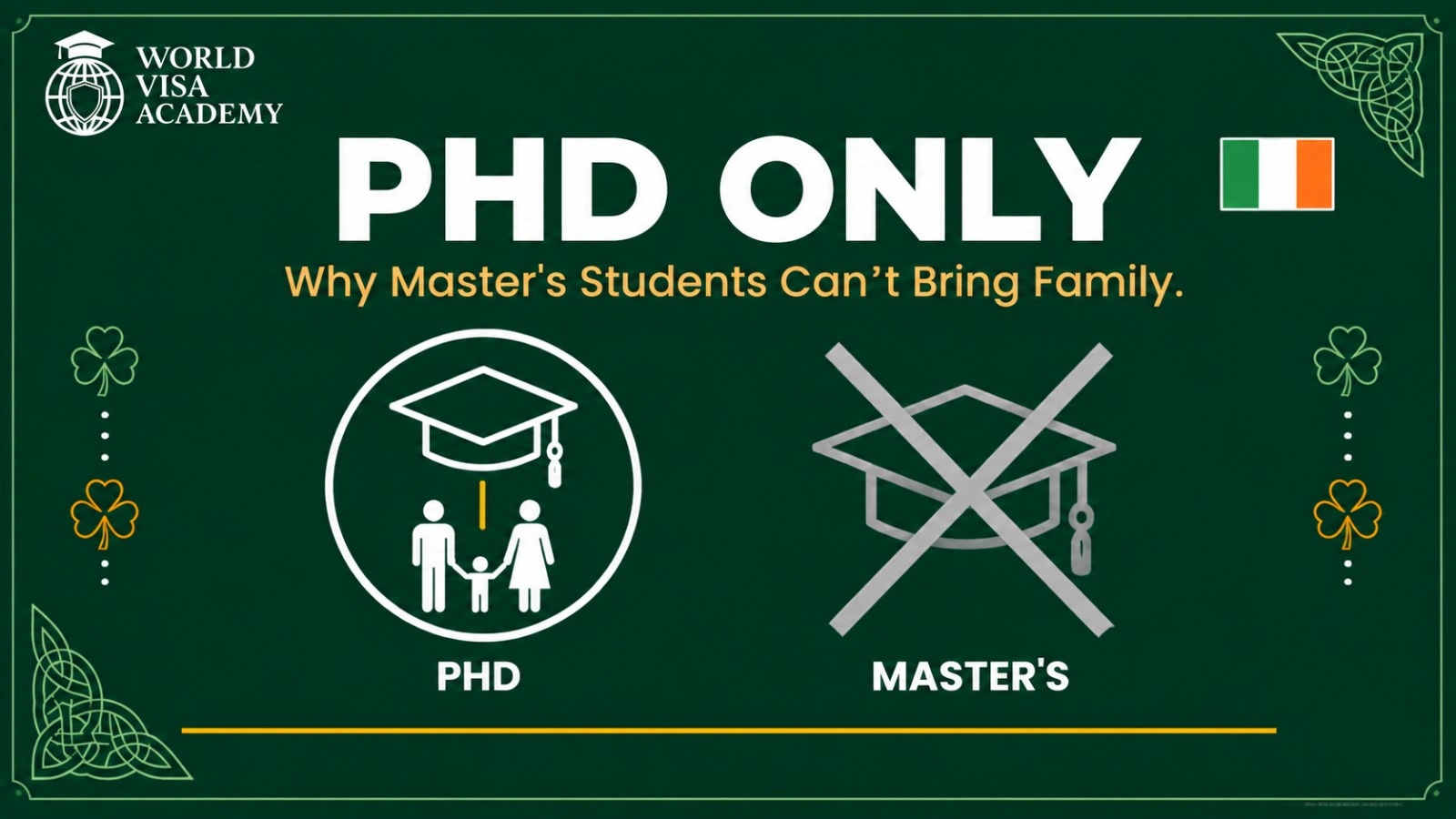
If you've come across the idea that Ireland lets master's and doctoral students both bring their family on a student visa, it's worth checking that against the source directly, because it's not quite right. Ireland's own Immigration Service Delivery website lists exactly one education based category eligible to sponsor a family member while studying: a PhD student pursuing a doctorate accredited in Ireland.
Master's students don't make that list. Neither do undergraduates, diploma students, or anyone on a short course. If you're a master's student hoping to bring a spouse or child to Ireland while you study, the honest answer, under current rules, is generally no.
This surprises a lot of people, understandably, since master's programmes are far more common among international students than PhDs. Getting this distinction right matters enormously for anyone planning a move that involves their whole family.
Who Can Actually Sponsor a Family Member as a Student in Ireland
According to Ireland's official family dependants guidance, you may be eligible to sponsor a family member if you are a PhD student studying for a doctorate accredited in Ireland, and you can demonstrate sufficient funds to support that family member. This sits alongside a small number of other sponsor categories entirely unrelated to study, such as Stamp 1, Stamp 4 or Stamp 5 residents who've met Ireland's family reunification residency requirements.
That's it, as far as students go. Everything else about the process, proving the relationship, showing you live together as a family unit, meeting financial thresholds, applies on top of clearing that first, narrow gate.
Who Cannot, and Why This Surprises So Many Applicants
Undergraduate students on Stamp 2 cannot generally sponsor dependants at all. Master's students, despite being postgraduate and often assumed to fall into a more privileged category, are treated the same way. English language students and short course participants are excluded too.
The confusion is understandable. "Postgraduate" naturally sounds like it should include both master's and PhD level study, and in most other immigration contexts, it does. Ireland's dependant sponsorship rule specifically narrows that further, down to doctoral study only, which is a distinction easy to miss unless you're reading the official guidance directly rather than a general summary.
What "Category B Sponsor" Actually Means
Immigration advisors in Ireland commonly refer to PhD students who meet this bar as Category B sponsors, a classification that allows for immediate family reunification with nuclear family members once the funding and relationship requirements are met. This label doesn't appear as formal terminology on every government page, but it's widely used across Irish immigration advisory services to describe exactly this group: doctoral students with an accredited Irish PhD programme and demonstrated financial capacity to support dependants.
The Exceptions Worth Knowing
There are a couple of narrower paths worth flagging to clients whose situation doesn't fit the PhD only rule cleanly.
State funded academic exchange programmes carry their own, separate allowance for family accompaniment in some cases, distinct from the general Stamp 2 student rules.
Stamp 2A, a related but different permission for students on courses not listed on the Interim List of Eligible Programmes, can in limited circumstances be granted to the spouse of certain financially independent students, including PhD students specifically, offering a secondary route worth checking for specific family configurations.
Neither of these opens the door for a typical master's or undergraduate student, but they're worth knowing about before telling a client flatly that no options exist.
What Happens to Family Members Once They're Approved
If a PhD student successfully sponsors a spouse or child, that family member generally receives Stamp 3 immigration permission. Time spent on Stamp 3 counts as reckonable residence toward Irish citizenship by naturalisation, provided the overall residency and other legal requirements are eventually met, which is a genuinely valuable long term benefit worth explaining clearly to families weighing whether a PhD path in Ireland makes sense for their whole household. Every dependant must also hold valid private health insurance and register with Immigration Service Delivery after arriving in Ireland.
Who Qualifies at Each Study Level
Study LevelCan Generally Sponsor Dependants?English language / short coursesNoUndergraduate (NFQ Level 6–8)NoMaster's (NFQ Level 9)NoPhD / Doctorate (NFQ Level 10, Irish accredited)Yes, with sufficient funds shownState funded academic exchangePossible, case by caseThe Post-Graduation Way Around This
For master's and undergraduate students, the more realistic path to family reunification isn't during study, it's after it. Graduates of NFQ Level 8 or above programmes can apply for the Third Level Graduate Programme, known as Stamp 1G, allowing them to remain in Ireland and seek employment, generally for 12 months after a Level 8 qualification, extending to 24 months for Level 9 and above. If that graduate then secures a Critical Skills Employment Permit, they become eligible as a sponsor and can bring their family at that stage.
In practice, this means a master's graduate's realistic family reunification timeline usually runs through employment first, not through the student visa itself. That's a meaningfully different plan than assuming dependant sponsorship is available from day one of a master's programme, and it's worth mapping out clearly with any client considering bringing family to Ireland.
[INTERNAL LINK: Ireland's Critical Skills Employment Permit explained]
What This Means for Consultants
- Correct this specific misconception early with every prospective master's student who has a family. Don't let a client plan around bringing dependants during their studies if they're not pursuing a PhD, since this is one of the more consequential details to get wrong.
- For clients specifically choosing between a master's and a PhD, make sure family reunification timing is part of that conversation if it matters to them, since the two paths lead to very different outcomes for their spouse or children.
- Map out the realistic post-graduation path clearly for master's bound clients with families, centered on Stamp 1G and the Critical Skills Employment Permit route, rather than leaving them to assume reunification simply isn't possible at all.
- Always verify current rules directly on Ireland's Immigration Service Delivery website before advising a client, since this is exactly the kind of detail that gets mischaracterized across secondary sources.
- Flag Stamp 2A as a case-by-case option worth checking, particularly for PhD student spouses, rather than assuming only the standard PhD sponsor route exists.
Quick Checklist Before Advising a Client on Ireland With Family in the Picture
- Confirmed the client's exact intended study level, since master's and PhD are treated completely differently for dependant sponsorship
- Explained clearly that master's students generally cannot sponsor family during study, even though the programme is postgraduate
- Discussed the Stamp 1G and Critical Skills Employment Permit pathway as the realistic route for master's graduates with families
- Checked whether a state funded exchange programme or Stamp 2A might apply to the client's specific situation
- Verified current financial support requirements for PhD sponsors directly through Ireland's Immigration Service Delivery website
The Bigger Lesson Here
This is a genuinely easy detail to get wrong, since the word "postgraduate" does so much misleading work in casual conversation. Getting it right the first time, rather than correcting a client's expectations after they've already committed to a master's programme, is exactly the kind of precision that protects a family's entire relocation plan.