6
US Visa Social Media Screening 2026: What Immigration Officers Are Really Checking
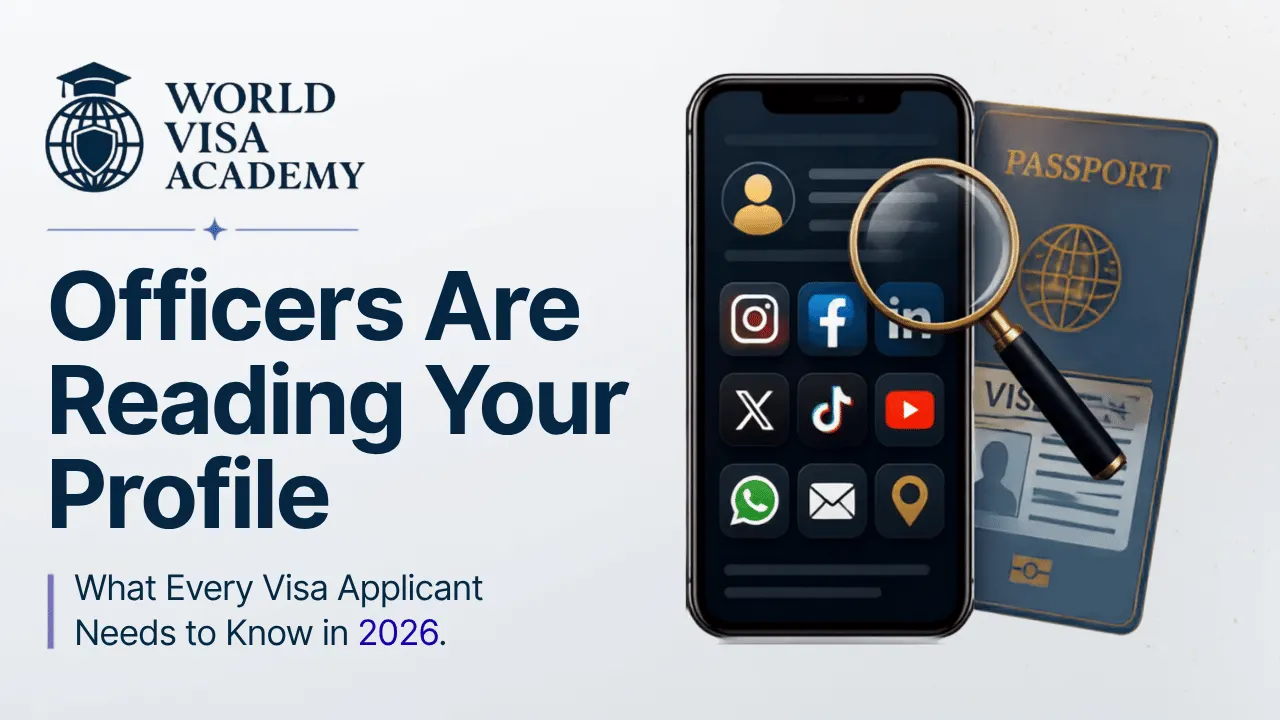
US consular officers now review visa applicants' social media as standard practice. Here is exactly which visas are affected, what officers look for, and what you actually need to do before your interview.
It sounds like a rumor until you read the actual policy. Consular officers reviewing a visa application today may genuinely look at an applicant's public Instagram, X, or Reddit history before deciding whether to approve a case.
This is not a conspiracy theory or a scare tactic used by agents to push paperwork. It is current, documented US State Department policy, and it has expanded sharply since mid 2025. This guide explains exactly what changed, who it affects right now, and what applicants should actually do about it.
This Did Not Start Overnight
Social media has technically been part of the US visa process since 2019. Every applicant for an immigrant or nonimmigrant visa has had to disclose social media platforms and usernames used in the prior five years on Form DS160, a group that adds up to roughly 15 million applicants a year.
What changed in 2025 and 2026 is not the disclosure requirement itself. It is a new layer of active screening on top of it, along with a demand that applicants make those accounts public.
Here is the timeline of how this expanded, based on official State Department announcements and cables reported by multiple news organizations and immigration law firms.
DateWhat HappenedSince 2019All nonimmigrant and immigrant visa applicants must disclose social media handles used in the past 5 years on Form DS160May 27, 2025State Department pauses all new F, M, and J student and exchange visa interviews worldwideJune 18, 2025A State Department cable orders consular officers to conduct full online presence reviews of F, M, and J applicants and directs them to make all social media accounts publicDecember 3, 2025 (effective December 15)Screening expands to H1B workers and their H4 dependentsMarch 30, 2026Screening expands to more than a dozen additional categories, including K1, K2, K3, R1, R2, H3, A3, C3, G5, Q, S, T, and U visasWhat Officers Are Actually Told to Look For
The June 2025 cable that started this expansion is unusually specific about what officers should search for. According to the cable itself, reviewed and reported on by CBS News, CNN, and immigration law firms who obtained copies, officers are instructed to identify applicants who show "hostile attitudes toward our citizens, culture, government, institutions, or founding principles."
The same guidance tells officers to flag anyone who appears to advocate for or support designated foreign terrorist groups, or who engages in unlawful antisemitic harassment or violence. Officers are told to use ordinary search engines and other public tools, and to keep screenshots as evidence of what they find.
One detail matters a great deal here. The cable explicitly states that vetting is not meant to be a fraud check. It is a separate, broader review of an applicant's character and views, layered on top of the usual document verification.
Refusing to make an account public is treated as suspicious in itself. Multiple sources report the guidance describes limited visibility as something that "could be construed as an effort to evade or hide certain activity."
Who Is Affected Right Now
This is the part most applicants get wrong, since headlines often say "all visas" without explaining the actual scope. Based on the confirmed timeline above, here is where things stand today.
Visa CategoryCurrent RequirementF1, M1, J1 (students, exchange visitors)Full public profile review since June 2025H1B, H4 (skilled workers and dependents)Full public profile review since December 2025K1, K2, K3, R1, R2, H3, A3, C3, G5, Q, S, T, UFull public profile review since March 2026B1/B2 (business and tourist visitors)Not formally included in the mandatory public profile list, though officers retain general discretion to review public content on any caseAll other nonimmigrant categoriesBaseline disclosure of handles required since 2019, with officer discretion to reviewThat last row matters a lot for WVA's audience, since B1 and B2 applications make up a huge share of daily visa work. The mandatory, cable driven review has not formally been extended to tourist and business visitors as of this writing. However, disclosure has always applied to them too, and any consular officer can look at publicly available information on any case at any time. Treat "not formally listed" as reduced risk, not zero risk.
What You Actually Need to Do Before Applying
- List every platform and handle you have used in the last 5 years on Form DS160, including accounts you no longer use or have deleted.
- If you are in an affected category, set all current, active social media accounts to public before your interview and keep them public through processing.
- Do not mass delete posts or accounts right before your appointment. Officers and immigration lawyers both note that sudden deletion looks more suspicious than an ordinary, consistent profile.
- Search your own name the way an officer would, and check that what is publicly visible is consistent with the details on your application.
- Review content on platforms outside the DS160 dropdown too. Regional apps such as Sharechat, Koo, or Moj still count as accounts you must disclose if you have used them.
- If you have posted on genuinely sensitive topics involving violence, terrorism, or hostility toward the US, speak with a qualified immigration attorney before your interview rather than during it.
Common Myths, and What Is Actually True
- Myth: A private account is safe from review. Reality: Disclosure is still required even if content is private, and officers may ask you to make it public.
- Myth: Officers read your private DMs and WhatsApp chats. Reality: Screening covers publicly visible content. One to one private messages are not part of it, though public broadcast channels are.
- Myth: Deleting everything before the interview helps. Reality: Sudden, complete deletion close to an interview date tends to raise more questions than it resolves.
- Myth: Sharing an opinion on your own country's domestic politics will hurt your US case. Reality: The "hostile attitudes" standard targets hostility toward the United States specifically, not commentary on unrelated domestic issues in your home country.
- Myth: This only applies to students. Reality: It began with students, but has expanded to workers, fiancés, religious workers, and several other categories, and continues to grow.
A Separate Track: Visa Waiver Travelers and ESTA
There is a second, related proposal that often gets confused with the visa screening described above. In December 2025, US Customs and Border Protection proposed requiring travelers from Visa Waiver Program countries, such as the UK, France, Germany, and South Korea, who use ESTA instead of a visa, to disclose 5 years of social media history as well.
This proposal is authorized under Executive Order 14161. Its public comment period closed on February 9, 2026, but as of the most recent public statements from CBP officials, it has not been finalized. CBP has since confirmed it will not take effect during the 2026 FIFA World Cup, and is revising the plan toward a narrower, risk based approach rather than requiring full disclosure from every traveler. A CBP official has indicated the earliest realistic finalization is late 2026.
This distinction matters for Indian travelers specifically. India is not a Visa Waiver Program country, so Indian citizens always apply through the regular consular visa process described earlier in this guide, not through ESTA. The ESTA proposal, even once finalized, would not apply to Indian applicants at all.
Legal Pushback Is Already Happening
This policy has not gone unchallenged. A federal case, American Association of University Professors versus Rubio, argued that using immigration enforcement to punish noncitizen students and scholars for protected political speech, specifically speech related to the Israel Gaza conflict, violated the First Amendment.
In September 2025, US District Judge William Young ruled in favor of the plaintiffs after a full trial. In January 2026, he issued a further order declaring the underlying policy unconstitutional and unlawful under US administrative law, and created a legal presumption that certain adverse actions against affected students would be treated as retaliatory unless the government proves otherwise.
This ruling is narrow in scope and specific to certain removal actions tied to political expression. It does not eliminate social media screening at the visa application stage. It does show that the policy is being actively contested in court, and consultants should expect this area to keep shifting.
What This Means for Visa Consultants
For consultants and travel agents, the practical risk with this topic is client panic, not client ignorance. People hear "officers are reading your social media" and assume every old post is a threat, when in reality the standard is specific and the mandatory review only applies to certain categories today.
World Visa Academy trains consultants to separate confirmed policy from rumor, explain category specific requirements accurately, and guide clients through preparing their online presence without encouraging panic driven deletion that can itself raise concerns.
[INTERNAL LINK: WVA course on US student and work visa documentation]
[INTERNAL LINK: WVA guide to F1 visa interview preparation]
Key Takeaways
- Basic social media disclosure has applied to nearly all US visa applicants since 2019.
- Mandatory public profile review is currently confirmed for F1, M1, J1, H1B, H4, and the March 2026 batch of categories.
- B1/B2 visitors are not formally on that list yet, but are never fully exempt from officer discretion.
- Officers are told to look for hostility toward the United States, not general political opinions unrelated to the US.
- The Visa Waiver Program and ESTA proposal is a separate, still unfinalized process that does not apply to Indian applicants.
- Never delete your history right before an interview. Consistency matters more than a clean slate.
This is one of the fastest moving areas in US immigration policy right now, and the scope has grown every few months since mid 2025. Anyone preparing a visa application, or advising someone who is, should check official guidance close to the actual interview date rather than relying on older news coverage.