
6
What Is the Donkey Route? How It Actually Works, and Why It Keeps Trapping Desperate Families
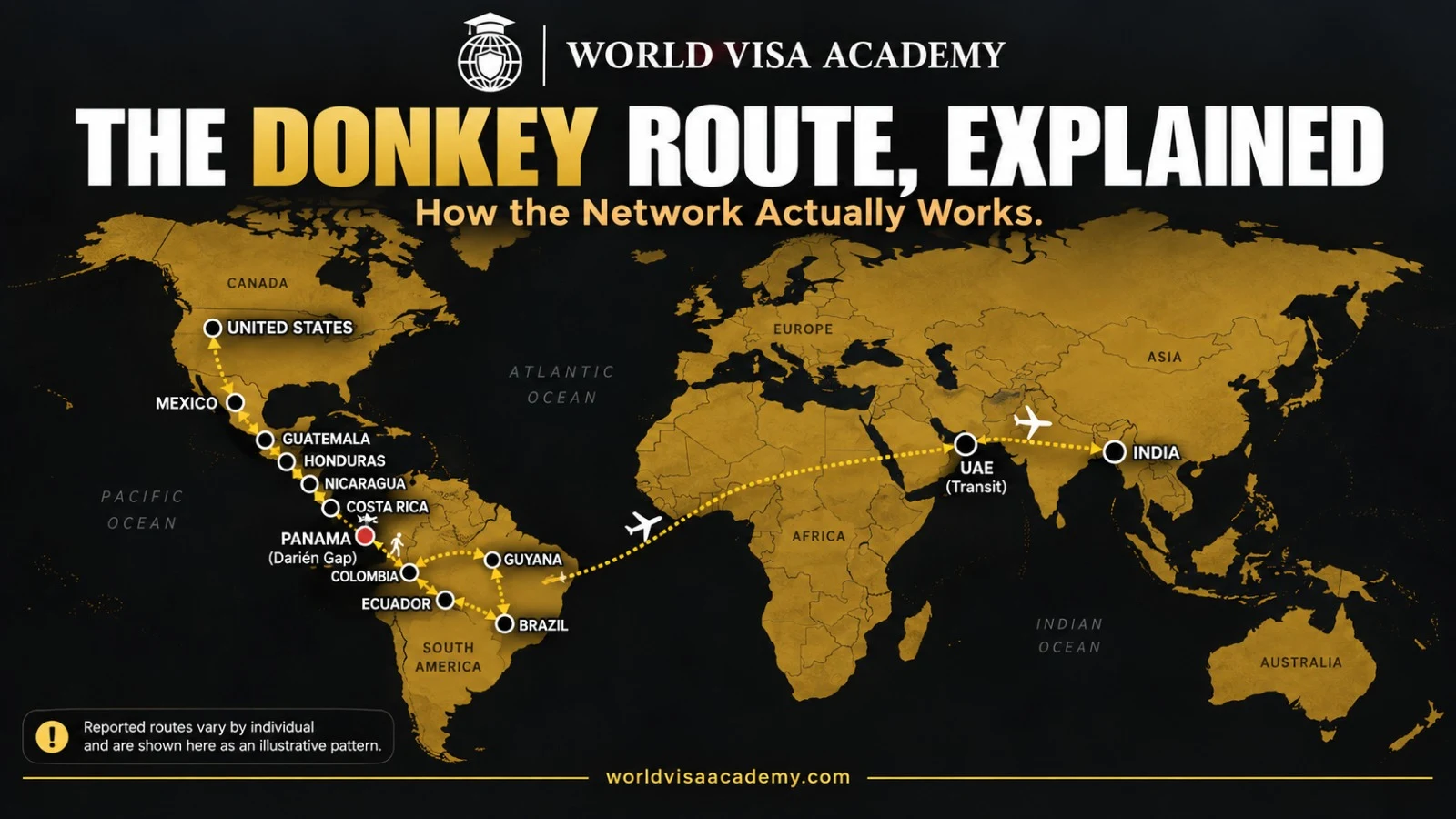
What "Donkey Route" Actually Means
The term sounds almost casual, but the reality behind it is anything but. Donkey route, also called dunki route, describes an illegal migration path that sends people through a chain of countries, often six or more, to reach the United States without a valid visa. The name itself comes from the sheer physical endurance the journey demands, long, grinding stretches on foot, by boat and by bus, much like the stubborn, slow trudge of a donkey.
What started as a pattern concentrated in Punjab has spread significantly. Reports now trace the same network operating out of Haryana, Uttar Pradesh, Himachal Pradesh and Gujarat, run by a web of visa agencies and local agents, some operating with a thin veneer of legitimacy, others openly tied to international smuggling networks.
Who Actually Runs These Networks
Understanding the donkey route means understanding the three layers of people who make it function, each with a distinct, well documented role.
Brokers work at the ground level, in small towns and villages across Punjab and Haryana. They are usually the first point of contact, the ones making big promises of guaranteed jobs or asylum abroad, and collecting massive sums from families who often mortgage land or take on serious debt to pay them.
Financiers sit above the brokers as the real organisers. They arrange forged or manipulated documents, coordinate logistics across multiple countries, and manage the money flowing through the entire operation, often through informal channels investigators have specifically linked to hawala transactions.
Donkers operate on the ground in Latin America and Mexico, guiding migrants through the actual physical journey day by day. They are also, according to documented accounts, the most direct source of extortion, abuse and exploitation migrants face once the journey is already underway and there is no realistic way to turn back.
The Journey, Stage by Stage
Most journeys begin with a flight, sometimes routed through the UAE, to a Latin American country that offers Indians easy entry, either visa on arrival or a straightforward tourist visa. Ecuador, Bolivia, Guyana, Brazil, Peru and Venezuela are the countries most commonly used for exactly this reason. Some agents attempt a more direct route, arranging a Mexican visa straight from Dubai, but this is considered far riskier, since arriving in Mexico directly raises a much higher chance of arrest by local authorities.
From that first Latin American entry point, migrants travel overland, by bus, boat and on foot, moving north through a chain of countries toward Colombia. This is where the journey turns genuinely dangerous.
The Darien Gap: The Deadliest Stretch
The most treacherous segment of the entire route is the Darien Gap, a dense, largely lawless jungle stretching between Colombia and Panama. It is one of the most inhospitable regions on earth, mountain ranges, thick rainforest and swampland with no real infrastructure and no meaningful law enforcement presence.
Migrants spend days crossing this terrain on foot, facing extreme physical exhaustion, disease, dangerous wildlife and, critically, criminal groups who effectively control passage through the area. Robbery and sexual assault are common. This is also where the line between smuggling and outright human trafficking tends to blur, with migrants becoming vulnerable to labor exploitation, extortion and debt bondage, entirely at the mercy of whoever controls that stretch of the route.
Those who survive the Darien Gap continue north through Panama, Costa Rica and Nicaragua, before reaching Mexico, which functions as the final staging ground, a place where migrants are deliberately kept moving to avoid drawing government attention before the last, most heavily guarded stretch.
What Happens at the End
The final barrier is the US Mexico border itself, heavily fortified and closely monitored. Migrants attempt crossing through various means, including the Rio Grande river, a crossing that carries a very real risk of drowning, alongside other high risk methods used to get past border surveillance.
For those who make it across, the journey does not simply end in freedom. Migrants are typically detained by US authorities almost immediately, and their case then moves into the asylum process, a legal procedure with no guaranteed outcome. A significant number are eventually deported. One widely covered case saw 104 Indian deportees flown back to Amritsar on a US military aircraft, several of whom described being kept in handcuffs throughout the journey with limited access to basic facilities, images that triggered strong political backlash and public outrage back in India.
Why Families Still Take This Risk
It is worth being honest about why people choose a path this dangerous. The motivations are rarely reckless. Families are usually driven by genuine economic desperation, a lack of opportunity at home, the hope of supporting relatives, or in some cases, fleeing genuinely difficult circumstances. Agents deliberately exploit this desperation, presenting the donkey route as a fast, almost guaranteed shortcut to a better life, when in reality it is neither fast nor guaranteed.
The Real Cost
The financial cost alone is staggering for most families attempting this route, with agents commonly charging between Rs 45 lakh and Rs 50 lakh per person for a journey they falsely present as a legitimate overseas placement. In some documented cases, agents have gone further, taking property documents as collateral, putting a family's home or land directly at risk on top of the cash already paid.
The human cost is harder to quantify but far more serious, physical danger throughout the journey, the constant risk of exploitation by donkers controlling each stage, and, even in the best case scenario of reaching the US, no guarantee of being allowed to stay.
How This Differs From Legal Immigration Pathways
FactorDonkey RouteLegal Immigration PathwayLegal status on arrivalIllegal entry, subject to immediate detentionLegal entry under a valid visa or approved statusTypical costRs 45 to 50 lakh, often with property put at riskGovernment fees plus legitimate consultancy chargesPhysical safetyHigh risk of injury, exploitation, or death en routeNo physical danger inherent to the application processOutcome certaintyNo guarantee of remaining in the destination countryClear, documented pathway with defined eligibility criteriaRecourse if something goes wrongLittle to none, often controlled by criminal networksLegal appeal processes and consumer protections availableLong term consequencesPossible entry bans, deportation record, asylum uncertaintyClean immigration record supporting future applicationsRed Flags That Signal an Agent Is Pushing This Route
- A guaranteed job or asylum offer abroad with no clear, verifiable visa category attached
- A vague or evasive explanation of exactly how the applicant will travel and enter the destination country
- Fees in the tens of lakhs for a placement that cannot be verified through any official channel
- A request for property documents or other high value collateral as security for payment
- Instructions to fly first to a Latin American country with no clear connection to the applicant's stated destination
- Pressure to avoid asking too many questions or involving family in the details of the arrangement
Why This Matters for Consultants
Every legitimate visa consultant will eventually meet a family who has been approached with this kind of offer, sometimes by a competitor, sometimes by a broker with no real credentials at all. Being able to clearly explain what the donkey route actually involves, the real danger of the Darien Gap, the near certainty of detention at the US border, the total absence of any legal guarantee, is one of the most valuable, protective conversations a consultant can have with a client considering it. It is also a direct, practical way to demonstrate the value of a properly documented, legal pathway instead.
[INTERNAL LINK: WVA Ethical Practice and Fraud Prevention Training]